

Article
Pandemic Learning: Paid Micro-Training Opportunities for Post-Pandemic Recovery
Brave New Work Blog Series
Released:June 28, 2021
Project: Brave New Work
By Peter Loewen and Blake Lee-Whiting
A cornerstone of the federal government’s response to the COVID-19 pandemic has been providing substantial income support to Canadians. This support kept families afloat, bolstered consumer confidence, and enabled many Canadians to stay at home to avoid infection. This approach has been a success. But what if, as part of a recovery package, government expanded this approach to include paid training programs? What if, for example, it had asked them to engage in reskilling or upskilling through short online courses in exchange for additional payments? We argue in this post that there would have been substantial support for this.
As the Canadian government considers post-pandemic recovery benefits, there is an opportunity to upgrade the skills of Canadian residents while providing post-pandemic economic relief. Canadian residents are eager to upgrade their job skills but, especially given the pandemic, those people for whom training would most improve their job aspects are financially hindered from pursuing additional job training. Governments can either ignore the immense talent pool of Canadians most impacted by the COVID-19 pandemic or respond by providing innovative new job training policies, reflective of the policymaking lessons learned during the pandemic.
This blog post examines the popularity of a post-pandemic paid micro-training program to help Canadian residents who were most affected by the COVID-19 pandemic improve their skillset while providing financial benefits. To study this approach, we ask if there is demand in Canada for paid micro-training programs among Canadians who have been negatively financially impacted by COVID-19. Our results suggest that:
- Canadians who have been negatively impacted by the pandemic are eager to receive government-assisted skills training;
- The majority of Canadians are eager to take paid life skills courses;
- Course time and remuneration is more important to Canadians than course topic when it comes to micro-training.
Pandemic-Era Policymaking
On March 25, 2020, one day before the Canadian federal government implemented the Quarantine Act in response to the COVID-19 pandemic, the COVID-19 Emergency Response Act received royal assent. Among several policies intended to counteract the negative economic impacts of the pandemic was the Canada Emergency Response Benefit (CERB), which provided a $2,000 per month taxable benefit to residents of Canada that earned at least $5,000 in the 2019 tax year but had to stop working involuntarily due to the COVID-19 pandemic.
The early days of the pandemic was a unique moment of “cross partisan consensus on important questions related to the COVID-19 pandemic, such as its seriousness and the necessity of social distancing.” Across the political spectrum, there was a general sense that major measures were needed to reduce the severity of the pandemic. The response by government was a new policymaking approach, wherein broad actions were taken quickly to maximize impact. PPF Fellow Jennifer Robson argues that “relative to pre-COVID-19 income support policy, [there] was a move to pay benefits on the basis of attestations by applicants rather than holding benefits until documentary evidence could be submitted, verified, and approved to support the claim.”
As Canada seeks to emerge from the pandemic, the federal government could consider expanding this “trust-but-verify” approach to policymaking during the recovery phase of the pandemic to maximize support while minimizing barriers to receiving benefits. One such way continue this approach is to implement a unique skills training program in which Canadians are rewarded financially for upgrading their job and life skills. This program could be targeted towards Canadians most affected by the pandemic, or merely to those who are interested in receiving a small benefit for completing an online course offered by the government.
To test the popularity of such a program, our lab (PEARL at the University of Toronto) surveyed 1,291 Canadians, including Canadians in every province, in May and June of 2021 using data provided by Abacus Data via Fulcrum, and hosted on the Qualtrics platform. Survey respondents reflect the age, gender, and regional of Canadians, acting as a mostly representative sample of the population. Further weighting of the data does not substantially change the results.
Our goal was to see what kind of reskilling people would be willing to take on, with a focus on those who received government income support during the COVID-19 pandemic. Accordingly, after collecting standard demographic data, respondents were asked if they had received federal aid during the pandemic and, if so, what amount of aid and from which programs. We administered the substantive questions described in our results section and administered a conjoint experiment. Finally, respondents were asked if they had lost a job or any income because of the pandemic.
Results
We provided respondents with the following hypothetical scenario:
Imagine that the Canadian federal government decides to offer you a voucher for a free course of your choice at any designated educational institution (accredited colleges or universities) so long as the institution accepts your application to take the course. Would you use this voucher program?
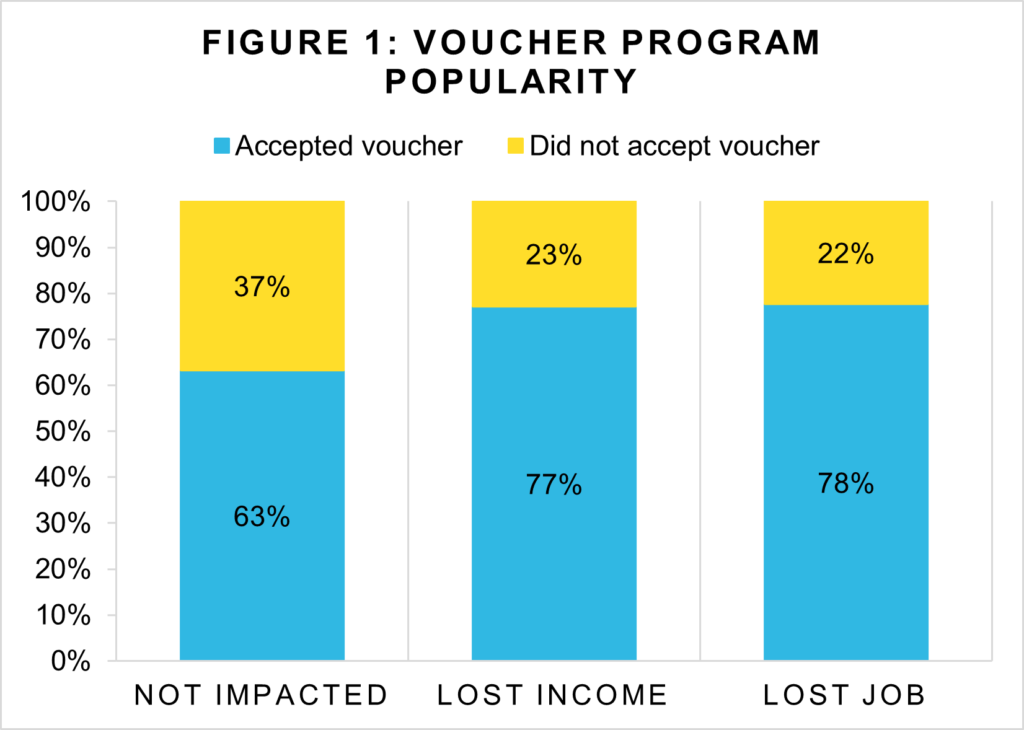
Across all groups, the voucher program is relatively popular; 67% of all respondents indicated that they would accept the program. For those who have either lost a job or income due to the COVID-19 pandemic, the voucher program is even more popular. As Figure 1 demonstrates, 78% of respondents who lost their job and 77% of respondents who lost income said they would accept the course voucher, compared to 63% of respondents who report not being financially impacted by the COVID-19 pandemic. Canadians who have been negatively impacted by the pandemic are eager for skills training.
What about more general skills training? To gauge this, we use cardiopulmonary resuscitation (CPR) as a benchmark. Unlike university or college courses which offer more generalized learning opportunities with more diffuse benefits, CPR has targeted health benefits for Canadian society that are immediately apparent; while some professions, particularly those in the health science fields, require CPR training, the premise here is that the Canadian government has an opportunity to provide an important life skill to Canadians as part of a COVID-19 recovery plan.
We gave Canadians the following prompt:
Imagine that the Canadian federal government decides to offer you $100 to take a 2-hour online course on how to properly administer CPR (cardiopulmonary resuscitation). Would you take this course?
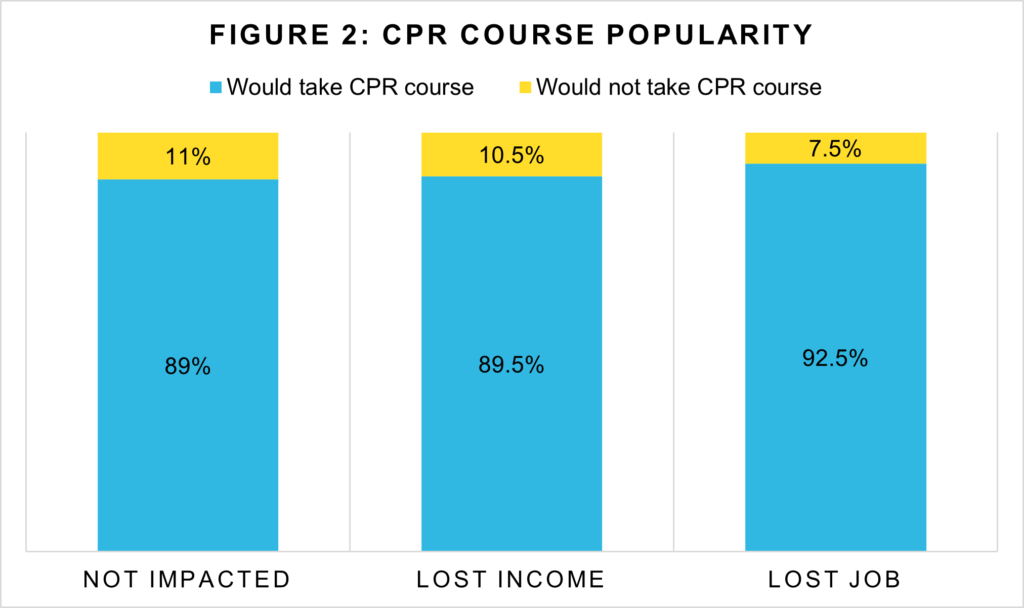
This course offering is immensely popular among Canadians: 89% of respondents who report not being economically impacted by the pandemic indicated that they would take the CPR course. This course offering is more popular still among Canadians who have been negatively impacted by the pandemic; Figure 2 shows that as the impact of COVID-19 increases, the popularity of the program increases slightly.[1]
While we examined two more general program designs, a course voucher for a university or college class and a paid CPR course, we also conducted a conjoint experiment to examine potential program designs. We presented respondents with several different program designs, varying topic, the time commitment of the program and the eventual payout. The conjoint preamble read as follows:
Imagine the following hypothetical scenario: The Canadian federal government has decided to create a program where you are rewarded for taking an online course on (“basic life support skills, such as how to do CPR , taught by a medical health professional”; “nutrition and at-home exercise techniques taught by an expert”; “how to file taxes in Canada as well as some financial literacy information taught by a professional accountant”, “Indigenous history and culture taught by an Indigenous scholar”). Completing the course and passing a short (15-30 mins) test will result in you being paid (“$50”, “$100”, “$200”). The course will take you roughly (“2″,”5″,”10”) hours to complete. The course is taught online using pre-recorded videos and content, so that you can learn and participate at your own speed. Would you sign up to take this course?
Figure 3 presents our results, estimated across all respondents. Each dot on the figure shows the increase in likelihood of people choosing a program given a characteristic. The horizontal lines are estimated confidence intervals. The dotted line indicates the mean baseline willingness to take the course; a circle to the left of the line indicates that characteristic decreases the likelihood of taking the course, while a circle to the right of the horizontal line suggests the factor increases likelihood above the average.
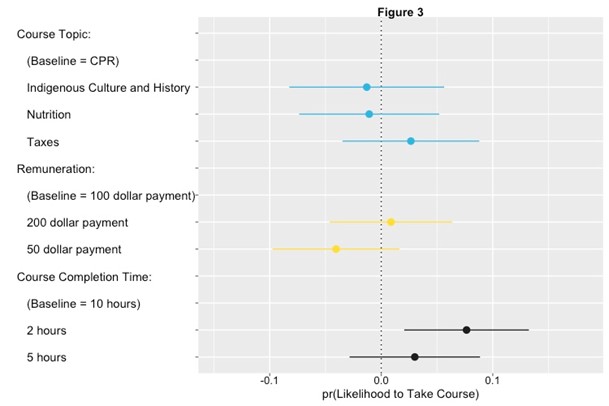
Our results are important. While respondents are more interested in shorter courses, the amount they are paid for each course does not much matter. Indeed, on the course length variable, respondents are 8 percentage points more likely to take a course that takes two hours to complete than a course that takes 10 hours. We do not find meaningful differences across the four topics, which indicates the government could offer a variety of courses, perhaps targeting them according to known and anticipated labour market needs.
Implications
The Canadian pandemic benefits plan has prioritized providing emergency aid to as many Canadians as possible. As Canada seeks to recover from the pandemic, Canadians who have been negatively impacted by the pandemic are eager to receive government-assisted skills training; many Canadians are likewise eager to receive paid life skills courses. This program design, in which Canadians are paid to upgrade their skills, could help to backstop the economy during the recovery period. Additionally, it could spur universities to create more online micro-content, help more Canadians develop the practice of lifelong learning, and shore up critical knowledge gaps in Canada’s workforce.
[1] Note here though that there are major ceiling effects, so any potential increase will naturally be limited.
Thank you to our partners
Thank you to our lead sponsor

Thank you to our partners

![]() |
![]() |
![]() |
![]() |
![]() |
![]() |
![]() |
![]() |
![]() |
Events
What We Learned: Brave New Work Round Up
PPF's flagship Brave New Work project is wrapping up by rounding up the perspectives and insights of over 20 of the people who contributed to the project over the years. We ask them what they learned about the future of work, and what they recommend needs to be done next.
Past Event
Turning Point 2020: When the Future of Work Became the Present
When we look back on 2020, we’ll see a turning point, but right now the destination is unclear. This free, 3-part virtual conference on the future of work in Canada was held on June 16, 17, & 18th, 2020.
Past Event
Work in Progress: Why jobs are changing and where are the opportunities for all?
And why are jobs changing? Join the Indigenomics Institute's Carol Ann Hilton and Microsoft's Edoardo de Martin for a dialogue facilitated by SFU's Mark Winston on June 14 in Vancouver.
Past Event
Brave New Work Conference
Technology, demographics and other factors are transforming the world of work – and quickly. Push aside the dystopian scenarios and watch this discussion that helped shape policy pathways to enable Canadians to thrive in the jobs of the future.
Reports
Automation, AI and COVID-19
A majority of Canadians indicate they have at least a basic understanding of AI and automation. Politicians have an opportunity to seize upon this perceived knowledge to address coming challenges by linking COVID-19 solutions to challenges — and potentially positives — presented by AI and automation. This new report by Peter Loewen and Blake Lee-Whiting shows signs that Canada has not seen a large populist backlash to the pandemic, but that could be coming, perhaps against immigration policies, if citizens feel the government is not following through on job creation.
Managing Transformation in Disrupted Sectors
There are lessons to be learned from industries that have survived and thrived through disruption, as well as those that have failed to navigate industry transformation. We need to learn from the past while we look for innovative ways of working together to rebuild the economy. To achieve these goals, we need to plan for inevitable change as all sectors, no matter how resilient writes Lori Turnbull. With the right tools, workers, employers and sectors can fortify themselves in a new economy.
Navigating Precarity in Non-standard Work
An estimated 30 percent of the Canadian workforce is engaged in non-standard, precarious work, with an inability to transition to something more stable. As the labour market has been upended by the COVID-19 pandemic, now is a critical time to examine what has played an integral part in shaping the current landscape of our labour market. This paper explores policy considerations around data, benefits and alternatives to envision a future where precarity does not have to be a reality.
Improving the Linkages between University and Work
COVID-19, the skills gap and automation have all conspired to change the work landscape in Canada and post-secondary institutions must respond to those changing needs. Add to that the fact that employers have been complaining for some time that new hires don’t have the skills the workplace demands, and you have a reason to re-evaluate the way universities operate. They tend to focus on content but employers are looking for cognitive and behavioural skills over content and disciplinary knowledge.
Emerging Stronger: Addressing the Skills Under-Utilization Challenge for the Future of Work in Canada
How can Canada use its highly skilled workforce as we transition to a knowledge economy? In their new report, AJ Tibando and Arvind Gupta explore Palette Inc., a not-for-profit platform that was created to upskill diverse and non-traditional workers in an ICT sector biased against hiring them. It looks like the Palette model is working.
The Future is Now: Creating Decent Work Post-Pandemic
Artificial intelligence, advanced robotics, the sharing economy and other emerging technologies were expected to upend the nature of how people work, eliminate an array of routine and repetitive tasks, and put pressure on social support frameworks designed for a different era. These impacts expected to be felt in the near to medium term suddenly find themselves present. The need to reinvent Canada's social and economic policy frameworks has a newfound urgency.
A Place-Based Lens to the Future Of Work in Canada
An urban-rural scan of potential long-term effects of the future of work shows the negative effects of a displaced workforce will be felt disproportionately among rural residents, who make up the majority of high-risk employment sectors that will succumb to technology-induced disruption. Understanding how these changes could affect urban centres vs. rural areas is a crucial ingredient to long-term policymaking and key to creating an effective place-based policy agenda for Canada to manage those disruptions and keep an urban-rural economic divide that already exists from growing
Managing Precarious Work: Three Canadian Models for Rebalancing Bargaining Power in the Future of Work
Hear the expression “precarious employment” or the “gig economy” and you’ll almost certainly think of the Uber driver who took you to the airport last week. However, precarious employment dates back much further. This report examines three entrenched models—construction workers, those in film and theatre, and those in academia—for recommendations governments can use to address the growing challenge of gig work.
Old Gigs, New Gigs: Are Courts and Legislators Reinterpreting an Age-Old Debate for the New World of Work?
Courts and legislatures are deciding whether your Lyft driver is an independent contractor or an employee. The classification is a big deal, affecting workers' protections through to retirement. This paper surveys the current state of the gig economy and how courts, tribunals and legislatures in North America and the UK are tackling the issue of employment classification.
Automation, AI and Anxiety: Policy Preferred, Populism Possible
Who is fearful of automation and what do they want politicians to do about it? This paper finds a correlation between Canadians’ fear of job losses from automation and populist and nativist views—but also that Canadians favour traditional government policy approaches to job disruption, such as retraining, more than radical measures such as reducing immigration.
Facilitating the Future of Work Through a Modernized EI System
Gaps in Canada’s Employment Insurance program are already leaving too many workers behind as gig work, part-time jobs and self-employment grow. EI needs to be modernized now to support Canadians as they transition to an economy and labour market disrupted by technology and automation.
Skills, Training and Lifelong Learning
Training for working Canadians is scarce, and the people who most need it are the least able to get it. As global competition and technological change increase, Canada needs to create effective and inclusive systems of training, which are essential for innovation, growth, employment and good incomes. In this report, Daniel Munro looks at Canada's strengths and weaknesses, training models from around the world, and suggests improvements to lifelong learning systems.
Articles
Commitment to lifelong learning is win-win for manufacturing company AVIT and its employees
A people-centric approach at AVIT Manufacturing in Peterborough, Ont. means that employees are continuously offered opportunities to upgrade their skills and learn new ones. AVIT provides a prime example showing that encouraging lifelong learning in workplaces is an asset. Read this case study by Daniel Squizzato on navigating precarity on managing transformation in disrupted sectors – all for PPF's Brave New Work project on the future of work.
Surviving Disruption in the Shipbuilding Industry
Irving Shipbuilding Inc. found itself in the middle of a rapidly changing shipping industry, and had to adapt to the evolving requirements of talent and infrastructure. Their grow-at-home approach may be the one to adopt in other disrupted sectors too. Read this case study by Sherry Scully on managing transformation in a disrupted sector – all for PPF's Brave New Work project on the future of work.
“It’s possible to make every job a good job, we just decide not to”: Lessons from the film industry for the gig economy
Millions of modest-income earners in Canada are precariously employed. The pandemic has created more unstable economic conditions than ever before--we need a plan for the future of precarious work. Read this case study by Catherine Lathem on navigating precarity in non-standard work – all for PPF's Brave New Work project on the future of work.
“I will have to work until the day I die”: Could portable benefits bring financial hope to essential workers caught in the messy middle of Canada’s economy?
Gig-work continues to grow in preference among workers for its flexibility, but increasing frustration surrounding the lack of benefits is proving to be an important challenge that needs to be tackled. Could portable benefits be the solution the gig-work economy needs? Read this case study by Catherine Lathem on navigating precarity in non-standard work – all for PPF's Brave New Work project on the future of work.
Federal program aims to support lifelong learning, but analysts call for changes
The government is looking for ways to support citizens in lifelong learning-- the Canada Training Benefit is one way of doing this. However, it may not be enough. Read this case study by Rosanna Tamburri on education innovation – all for PPF's Brave New Work project on the future of work.
As a means of reskilling Canada’s workforce, are microcredentials a boon—or just hype?
Microcredentials are emerging as a popular method for upskilling, but their lack of standardization, among other concerns, may impact whether or not these programs are here to stay. Read this case study by Rosanna Tamburri on education innovation – all for PPF's Brave New Work project on the future of work.
UHN’s Michener Institute “revolutionized” health care training. Does it hold lessons for other sectors?
The Michener Institute is the only postsecondary institution that directly works to meet the immediate needs of the healthcare system. "The Michener Model" may not only be valuable for Canada's evolving healthcare landscape, but may also have transferrable learnings for other sectors, too. Read this case study by Rosanna Tamburri on education innovation – all for PPF's Brave New Work project on the future of work.
It’s not a problem we need to solve, it’s really about good management
As the world of work continuously shifts, modernizes and innovates, what moves can be made to get and stay ahead when it comes to making work more accessible? PPF co-hosted The Future of Accessible Work panel discussion with Microsoft Canada featuring national and international accessibility leaders & advocates. This speaker series engaged PPF members to learn about accessibility and inclusion straight from the experts. To keep the conversation going and share our lessons learned, we have encapsulated five significant takeaways from the discussion.
Brave New Work Newsletter #4
In the fourth edition of our Brave New Work Newsletter: Our latest report on rebalancing bargaining power in the future of work, a panel discussion on the future of Alberta's energy sector, and two of our latest blog posts.
Stewarding AI and cultural change: It’s everybody’s business
What will it take to steward digital development and support workers and the broader public as we transition to a more automated future? Emerging leaders from the Banff Forum say the underlying principles we follow – and insist on – may make all the difference.
Moving gig work into good work: Making sense of the new legal landscape around the gig economy
The debate over the employment status of gig workers continues to play out in California legislation. What can Canadian regulators learn for our own first attempts at legislation from California’s decision to enact Assembly Bill 5?
Learning to Change: Worker Resilience and Adaptability
What does it mean to be adaptable and resilient as a worker, in the face of radical changes to work? With a focus on Alberta, emerging leaders from the Banff Forum and the City of Edmonton discussed policy lessons and policy solutions to prepare individuals and employers for workforce change.
Paycheque to Paycheque: Coping with Income Volatility as Work Changes
What can we do about workers living paycheque to paycheque, with the rise of the gig economy and future changes to work? Emerging leaders from the Banff Forum gathered and came up with a holistic set of policy measures for improving the well-being of workers and to help prevent economic marginalization as work changes.
Brave New Work Newsletter #3
In the third edition of our Brave New Work Newsletter: Five things we learned at our Brave New Work Conference, our latest report on the correlation between Canadians’ fear of job losses from automation and populist and nativist views, and a new blog post on why 'robots will replace us' thinking is not that simple - or that scary!
Robots will replace us!
The most popular way of analyzing the future of work — the labour substitution model — is far too narrow for our complex world. By looking at three other dimensions of change, we can better understand, and prepare for, tomorrow’s opportunities.
Five big things we learned at the Brave New Work Conference
The prospect of losing our jobs to automation may keep us up at night and change our politics, but there are other factors at play, too. Here are five key challenges and some smart policy responses that emerged at the inaugural Brave New Work Conference.
Report Preview: Do Canadians’ fears about automation push them to populism?
In an upcoming report for PPF’s Brave New Work project, Peter Loewen and Benjamin Allen Stevens find a correlation between Canadians’ fear of job losses from automation and populist and nativist views—but also that they favour traditional government policy approaches to job disruption, such as retraining, more than radical measures such as reducing immigration.
Why the future of work may be the most pressing issue of our time
Today’s technological revolution holds out tremendous promise to improve our lives and work, writes PPF's President and CEO Edward Greenspon, but we must ensure its opportunity is available to all, and that policy softens the downsides of the disruption it causes. Join our Brave New Work project to be part of the solution.
The future of work is a gender equity issue
Job displacement could disproportionately push women out of the workforce in Canada's jobs future. Women fill many of the lower-paid, often precarious jobs and if contingent work becomes more common it will entirely disrupt the notion of a career ladder - and leadership positions are already dominated by men.
Brave New Work Newsletter #2
In this second newsletter: New report on big gaps in Employment Insurance, emerging leaders share principles for inclusion that we should all follow, and we learn how disrupting the career ladder creates challenges to gender equity.
How do we build an inclusive future of work?
Emerging leaders from the Banff Forum gathered to discuss: Who is missing from Canadians' dialogue about our brave new world of work? They came up with a clear set of guiding principles and recommendations for policymakers.
Brave New Work Newsletter #1
In this first edition of our Brave New Work Newsletter: A new report on the strengths and weaknesses of Canada's training systems, what Canada’s associations see trending in the future of work, and students imagine how Canadians would learn if universities and colleges no longer existed.
Canada’s Associations See What’s Trending in the Future of Work
From new ways of approaching lifelong learning to recognizing that technology is not the only driver of workplace change, representatives of Canadian associations shared their perspectives on the changing nature of work and how workers and employers are affected.
Using Foresight to Explore the Future of Work
What happens when university students imagine how they would learn if universities and colleges no longer existed? As part of PPF’s Brave New Work project, we invited students from the Arthur Kroeger College of Public Affairs at Carleton University to do a foresight exercise on the future of learning, skills and access. They had some fascinating ideas.
Three ways to reduce anxiety about the future of work
Rapid change in how we work can stoke fears of a jobless future, but these key policy changes can help turn anxiety into opportunity.
News
Public Policy Forum and TD Bank Group announce multi-year Future of Work strategic partnership
During the April 12 Testimonial Dinner, TD Bank Group's Norie Campbell announced a three-year initiative with PPF to advance a pan-Canadian policy dialogue on the changing nature of work.