

Article
Project Evaluation Executive Summary (January – March, 2018)
Released:July 19, 2018
Project: Immigration & Atlantic Revitalization, Z - Atlantic Revitalization
Project Description
The Atlantic Revitalization Project (ARP) is a three-year undertaking by the Public Policy Forum (PPF) to bolster the success of the Atlantic Growth Strategy. The overarching purpose is to help address the demographic issues of an aging — and in some places shrinking — population in Atlantic Canada. The aim of the ARP is to explore and provide a deep understanding as to why some people stay and some people leave, and to understand the push and pull factors that determine whether newcomers to the region choose Atlantic Canada as their permanent home.
Evaluation Description
Wisdom 2 Action (W2A) will be the third party evaluator for the duration of the project and will use developmental and impact approaches. The evaluation seeks to inform the development of the Atlantic Revitalization Project by helping determine its priorities and assess progress against objectives. It will assess PPF’s progress against annual and overall goals and objectives, and quantify what is working and what needs modification. It will also inform the innovation of the project by helping determine priorities and adjust the course of the project as needed.
Interviews with key informants will inform project adjustments and bring new topic areas into PPF’s work, ensuring research and engagement responds to the interests of stakeholders. The developmental evaluation in the first year assessed early progress and focused on co-developing research, evaluation and policy questions for years two and three. In year two, the evaluation will focus on assessing increased knowledge and awareness of best practices related to immigrant retention, and measure the development and outcomes of new collaborative relationships. In year three, the evaluation will continue to assess reported increased knowledge and awareness, and also start to review project outcomes with stakeholders, including assessing the influence of the project on decision making and policy change within Atlantic Canada.
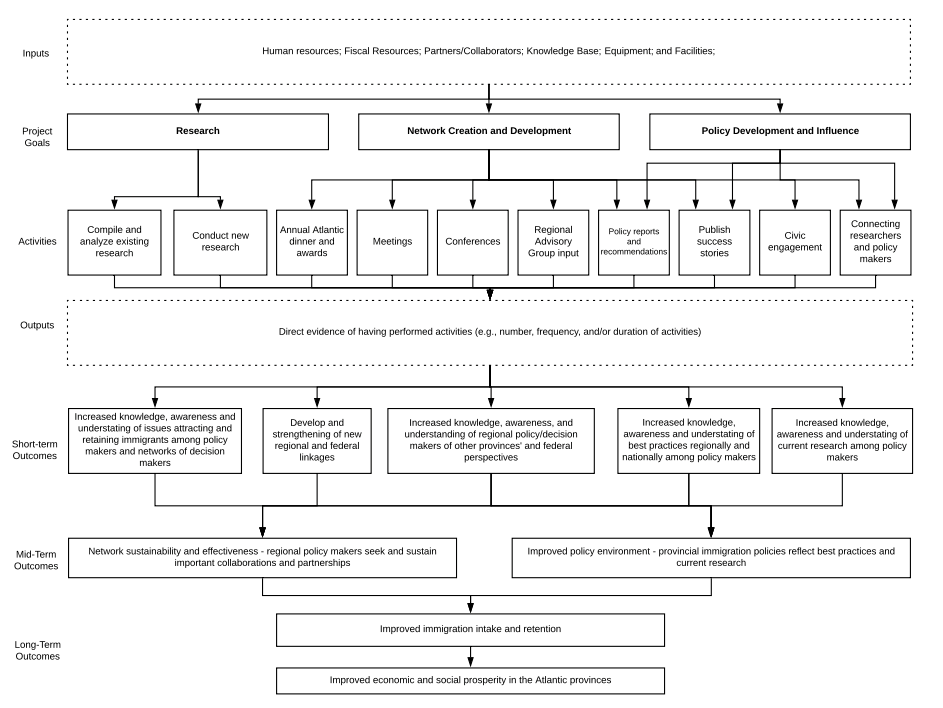
The W2A evaluation team worked with PPF staff to identify and create a project logic model (see page 3) that articulates the project’s underlying theory of change, with associated indicators to be measured throughout the duration of the project. As a developmental evaluation, program theory and key indicators are subject to change as information is fed back to the program and changes are made. The evaluation uses mixed-methods analyses and incorporates key informant interviews with data from online questionnaires to audit program processes, assess fidelity and set a baseline for the outcome related evaluation questions.
Evaluation Questions
Is PPF’s Atlantic Revitalization Project doing what it needs to be doing in the following three areas?
- Research and advancing knowledge
- Network creation and development
- Policy development and influence
Evaluation Findings and Interpretation
The Atlantic Summit conference was advertised regionally and nationally, and sold 225 tickets with 93 more sold for the follow-up dinner and award ceremony. The majority of interviewees said the information at the conference and in the reports was presented well, that they will reference the findings in their own work and that the second report, which used storytelling to highlight challenges and opportunities for newcomers, was insightful. Interviewees requested more stories from immigrants, a focus on regional context when presenting data and continued dissemination of the information in the reports through local media sources.
PPF’s Atlantic Summit conference and reports were viewed positively as a commitment to working with stakeholders across the Atlantic region. Although it is still too early to gauge the impacts of network creation, some interviewees said the conference experience allowed them to meet and converse with new people on the topic of immigration. A shared request was for more members of the private sector to be included in future conferences, and for more practical advice to be provided to organizations, employers and the layperson regarding what they can do to welcome and retain newcomers to the region. Interviewees also commented positively on PPF’s unique position as an outsider to help continue strengthening networking efforts in the Atlantic region and nationally. Suggestions were made for collaboration with local policy and research organizations, and to continue highlighting projects that local immigration organizations are working on.
Evaluation questions on policy development and influence will be addressed in future evaluation reports.
Reports
According to Atlantic Employers
What did a survey of over 800 Atlantic employers tell us about their outlook and activities to drive business growth before COVID-19? Explore our findings in five thematic reports and what it means for supporting employers as economies rebuild.
Go Big, or Go Home? Refocusing Entrepreneurship for Productive & Inclusive Growth
Entrepreneurship has been called the backbone of the economy. Despite the popularity of hoodie-wearing CEOs and global tech innovations, broad-based entrepreneurship that fuels local productivity and helps solve real-world problems has declined across developed nations. Canada is no exception. COVID-19 has added to the challenge. As Canada recovers, how do we get entrepreneurship back on track?
Solving for Shortages in Prince Edward Island: Employer Experiences and the Labour Market Across Atlantic Provinces
Employers across Atlantic Canada are facing skills shortages and are turning to newcomers to fill job vacancies. Yet retention in the region remains a problem, and many immigrants who relocate elsewhere in Canada report employment as a leading cause for their decision to move away. A consultation with local business leaders, business council representatives, educators and immigrant workers provided insights into challenges and policy opportunities.
Solving for Shortages in Newfoundland & Labrador: Employer Experiences and the Labour Market Across Atlantic Provinces
Newfoundland and Labrador's labour force is shrinking — not to mention population — and once again more people are leaving the province than arriving. PPF developed recommendations to upskill existing workers and bring in new workers at a St. John’s consultation with leaders in government, civil society, immigration, education institutions and business as part of our Atlantic Revitalization project.
Solving for Shortages in Nova Scotia: Employer Experiences and the Labour Market Across Atlantic Provinces
Employers across Atlantic Canada are facing skills shortages and are turning to newcomers to fill job vacancies. Yet retention in the region remains a problem, and many immigrants who relocate elsewhere in Canada report employment as a leading cause for their decision to move away. A consultation with local business leaders, business council representatives, educators and immigrant workers provided insights into challenges and policy opportunities.
Solving for shortages in New Brunswick: Employer Experiences and the Labour Market Across Atlantic Provinces
Employers across Atlantic Canada are facing skills shortages and are turning to newcomers to fill job vacancies. Yet retention in the region remains a problem, and many immigrants who relocate elsewhere in Canada report employment as a leading cause for their decision to move away. A consultation with local business leaders, business council representatives, educators and immigrant workers provided insights into challenges and policy opportunities.
Making EI Work: For Consistent Economic Growth and The Atlantic Seasonal Workforce
Where seasonal work is more common, what kind of EI reform would both protect workers and help create prosperous local labour markets? This paper explores six options focused on Atlantic Canada, arguing that widespread use of EI by seasonal workers makes it seem there's more unemployed workers than is really the case – a distortion that negatively impacts the economic potential of the region.
Solving for Shortages Series: Employer Experiences and the Labour Market Across Atlantic Provinces
Explore the findings of PPF regional consultations in Atlantic Canada in a province-specific report on employers and communities experiences with skills and labour shortages in context to key provincial factors.
People-Centric Economic Development: Lessons on International Student Retention from Atlantic Canada
The economic fortunes of rural Canada depend on attracting human capital, and while international students are highly skilled & qualified candidates for settlement, they don't often stick around. PPF Fellow Sean Speer identifies lessons from two promising programs in Atlantic Canada which seem to be convincing students to settle, against the odds.
PPF Atlantic Summit 2018
The Public Policy Forum’s 2018 Atlantic Summit is the first major initiative in a 3-year project. From 2018-2020 we will conduct research, engage communities and decision makers, and work to support the momentum building behind the Atlantic Growth Strategy. The focus of our first year has been on demographics and the role of immigration as one approach to attract, and keep, the talented people who make Atlantic Canada home.
The People Imperative: Strategies to Grow Population and Prosperity in Atlantic Canada
Atlantic Canada is taking action to rebuild its aging and slow-growing population: The region needs to attract - and keep - more newcomers.
Articles
Atlantic Newsletter #6: People-centric economic development & taking stock of all things skills
In the sixth edition of our Atlantic Newsletter, our latest report explores how is Atlantic Canada working to retain international students and our Skills Next series looks at what Canadians will need to succeed with the changing nature of work. Plus: a sneak peak at upcoming reports on Atlantic growth & save the date for the 2020 Atlantic Immigration and Revitalization Summit and Frank McKenna Awards Dinner.
Atlantic Newsletter #5: Immigrant entrepreneurs
In the fifth edition of our Atlantic Immigration & Revitalization Newsletter, Kelly Toughill looks at what Atlantic Canada is doing to attract newcomers who will start or take over businesses, create jobs and build the economy. Successful immigrant entrepreneurs share their lessons learned and give advice to fellow and future entrepreneurs.
Analysis: As opposition to immigration grows elsewhere, Atlantic Canadians’ support is strong—and rising
The Atlantic region is consistently becoming more supportive of immigration than any other part of Canada, which is now paying dividends in population growth driven by newcomers
Immigrant entrepreneurs: Highly desired, hard to attract
Atlantic Canada is competing globally to attract newcomers to start or take over businesses, create jobs and build the economy. It’s obvious why governments want to recruit them, but it’s surprisingly hard to do.
Carina Lin: Be patient
Lin expected to spend $150,000 and launch her New Brunswick candy business in a little more than a year. It took more than three years and $650,000. She praises government settlement and business support programs, but wishes they weren’t so hard to find.
Wadih Fares: Save money and look for an empty niche
Nova Scotia’s premier developer feels an obligation to talk about why he came to Halifax from Lebanon, why he stayed, and why immigration is good for Canada
Joe Teo: Integrate as quickly as possible
The co-founder of HeyOrca! launched the social media solutions company because he wanted to learn how to run a business. It worked.
Tareq Hadhad: Adapt your product to the Canadian market
The CEO of Peace by Chocolate is on a mission to spread hope—and to be a major player in Canada’s candy market
Atlantic Newsletter #4: How small communities in rural areas can attract and retain newcomers
In the fourth edition of our Atlantic Immigration & Revitalization Newsletter, PPF and research associate Kelly Toughill explore the challenges that rural areas face when attracting and retaining newcomers and the barriers that newcomers face when living in small communities.
For Acadians, newcomers are economic saviours but linguistic threats
The Acadian shore of Nova Scotia is one of many rural areas of Atlantic Canada betting its future on immigration. But even French-speaking newcomers aren’t a solution to preserving the area’s Francophone heart.
Opinion: The corrosive power of “Where are you from?”
Opinion: If Atlantic Canadians are serious about boosting immigration and making newcomers feel welcome, writes Kelly Toughill, we need to find a way to have real conversations about regional culture and the come-from-away phenomenon.
Mill town’s struggle reveals rural areas’ unique immigration challenges
A small influx of foreign workers has sparked sharp reactions in Chipman, New Brunswick. Many see the newcomers as potential saviours of a town headed toward extinction. Others see them as competitors for local jobs. In between, a handful of immigrant families are trying to figure out how to feel at home. The challenges of immigration in small communities are different than in cities, both for newcomers and for local residents. Solving them may be key to the future prosperity of rural Atlantic Canada.
Keeping international students in Atlantic Canada: EduNova’s big experiment
Why don’t a quality education, strong language skills and an open work permit guarantee success in Atlantic Canada? Fewer international graduates stay in this region after graduation than any other. Students and their advocates tell KELLY TOUGHILL what can be done to counter the trend.
Opinion: The danger of over-selling the Canadian dream to international students
Canada is becoming dependent on the economic stimulus of international students, writes KELLY TOUGHILL, but are we promising more than we can deliver? Many international students will face difficulties adjusting to Canadian academic systems, finding work, making friends and securing permanent resident status.
Atlantic Newsletter #2: What we can learn from refugees’ success in Atlantic Canada
In this second edition of our Atlantic Immigration & Revitalization Newsletter, PPF research associate Kelly Toughill talks to leaders and refugees across Atlantic Canada to understand what we can learn from their higher retention rates and overall success
Refugees stay put more than other newcomers do – but why?
Access to more settlement services, easier family reunification and safety are among the myriad reasons refugees tend to stay where they settle in the Maritimes, writes Kelly Toughill
Opinion: Provinces should be able to nominate siblings and cousins of newcomers
Our immigration system pits family reunification against Canada’s economic needs. That’s short-sighted and counterproductive, argues Kelly Toughill
Can refugees help save PEI’s way of life?
Some employers and advocates want Canada to recruit refugees to fill local labour shortages, Kelly Toughill reports. Others worry that would dilute the humanitarian mission of resettling the world’s most vulnerable citizens.
PPF’s new Atlantic newsletter tracks immigration and employment
Atlantic Canada faces profound demographic changes that challenge its future prosperity and economic sustainability. With a new email newsletter, the Public Policy Forum will keep you up to date on our three-year research project on immigrant retention and labour market revitalization in the region and share other timely research and articles.
Atlantic Immigration Pilot by the numbers
More than 3,000 job offers had been made through the program by the end of October 2018, but only 1,202 workers, spouses and children were granted permanent residency through the program in the same period. Immigration, Refugees and Citizenship Canada is trying to speed up the pace of permanent residency admissions.
Pulling up roots: Bhutanese exodus from Halifax offers clues to why newcomers stay or go
The disappearance of Bhutanese from Halifax is discouraging to those who believe the future of Atlantic Canada is tied to increased immigration, but it is also an opportunity to look at the factors that encourage newcomers to take root – and the factors that lead them away.
Putting down roots: How community gardens help immigrant retention
Cultural food security is key to how and whether immigrants take root in their new home. In Halifax, Common Roots Urban Farm was the only source of some traditional foods for newcomers, but the community garden was shut down and no one knows where – or if – it will rise again.
Changes to Atlantic Immigration Pilot praised, but more are needed
Revealing the list of employers authorized to bring immigrants to Canada through the Atlantic Immigration Pilot is an important first step in combating immigration fraud.
Conference Recap: PPF Atlantic Summit
The summit, which attracted hundreds from around Atlantic Canada, kicked off PPF’s three-year policy research project on Atlantic revitalization, with a special focus on newcomer retention.
How Atlantic Canada businesses keep their foreign workers
Whether they wear steel-toed boots or ballet slippers, workers from abroad are in high demand in Atlantic Canada. As Kelly Toughill found, successful companies have learned that keeping recruits happy requires more than a paycheque
Events
Past Event
Atlantic Summit 2020
How does Atlantic Canada need to pivot priorities for regional economic growth and immigration for post-pandemic prosperity? Atlantic Summit 2020 brings together leaders in policy development, government, business, education and social services for a forward-looking exploration of what it will take to confront old challenges compounded by new crisis.
Past Event
Nova Scotia Employer Consultation: Finding and Retaining Skilled Workers
Employers across Atlantic Canada are facing labour and skill shortages. Retention of young people and newcomers in the region remains a challenge, and many people who relocate elsewhere in Canada report jobs as a leading cause for their decision to move away. To truly understand the issues that Atlantic Canada is facing, PPF and Professor Tony Fang from Memorial University are conducting a roundtable discussion in Nova Scotia to learn about employer experiences and priorities regarding hiring and retaining skilled workers.
Past Event
Atlantic Summit: Immigration & Revitalization
Atlantic Canada needs newcomers. Join ACOA's Francis McGuire, IRCC's Marta Morgan and the region's top thinkers on Fredericton on March 21 for a full-day conference on attracting immigrants - and how to keep them.
News
Migrants find jobs, prosperity — if they stay in region
Immigrants who stay in Atlantic Canada have higher employment levels, higher wages and face less discrimination than immigrants to other parts of Canada, yet the region struggles to attract newcomers and has the lowest retention rates in Canada.
Former N.B. premier says future of Atlantic Canada reliant on immigration
“I don’t think it’s overly dramatic to say the future of Atlantic Canada is at stake,” former N.B. Premier Frank McKenna told the crowd of business leaders and academics at PPF's Atlantic Summit in Fredericton. His concern over the dwindling population of the region is buoyed by optimism about recent action taken by the four provinces and the federal government.