
Project
Rebuild Canada
Using the COVID-19 pandemic as a catalyst for a productive, resilient, and fair economy and society
[pdf row=”1″]
About the Project
The Public Policy Forum is tapping into the best established and ascending policy brains in an effort to help policymakers weigh priorities and trade-offs and forge a rebuild plan. PPF’s Rebuild Canada initiative lays down a foundation of insights, ideas, options, and strategies for turning the COVID-19 pandemic into a catalyst for something greater than a return to the pre-cataclysm status quo. It begins with a series of papers, written by an array of leading policy thinkers, addressing key themes such as:
- the macro-economy, Canada’s Twin Deficits & How to Scale Them by David Dodge;
- the determinants of growth and competitiveness; read How COVID-19 has shifted businesses’ priorities as they focus on recovery by Georgina Black and Anthony Viel;
- geopolitical relations; Navigating Canada’s Post-Pandemic Foreign Policy, by Roland Paris;
- labour market and income security, such as this paper by Jennifer Robson, EI Failed so we Made CERB and by Jim Stanford: Work after Covid
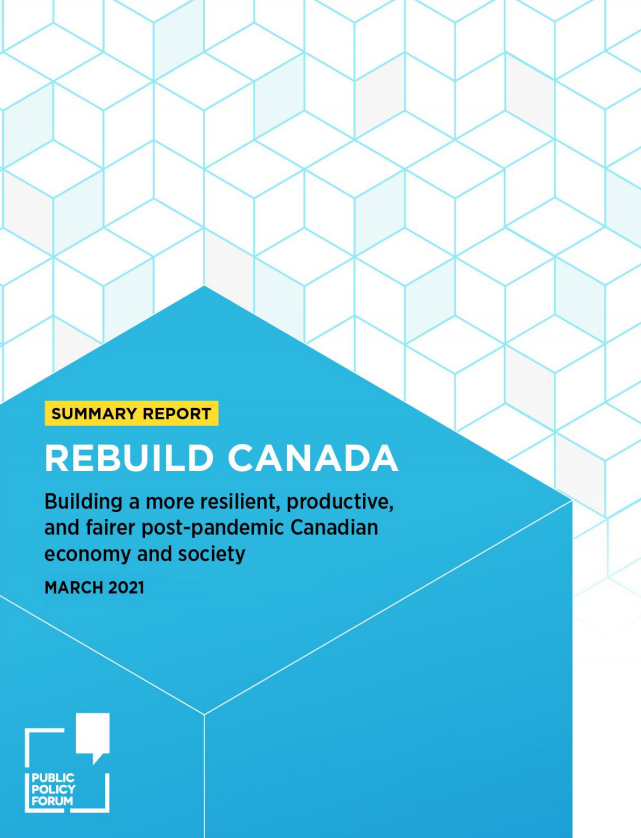
Online convening of a broader group of thinkers, doers and policymakers resulted in a second round of more focused policy briefs, culminating in the Rebuild Canada Growth Summit. October 19th to November 19th. The conversation on rebuilding the country continues and in the Rebuild Canada Summary Report, we’ve made it easy for you to access the scope of the 22 papers and roundtables. We encourage you to read this summary report and dive back into papers you may wish to revisit.
Events
Reports
A Model for Canada-wide Population and Economic Growth Post-Pandemic
As we move toward rebuilding our economy, policymakers should consider the success of the Atlantic Immigration Pilot as a model for regionally focused population and economic growth, especially in smaller cities and rural communities – likely to be hardest hit by the COVID-19 reduction in immigration.
Revitalizing Canada’s Manufacturing Economy for a Post-COVID World
COVID-19 has made it clear that Canada needs a strong domestic manufacturing sector to produce what it needs. Industrial production has been stagnant in the country for two decades and it’s a must for Canada to create and sustain a resilient manufacturing economy that will also be more competitive in a globalized economy and that will create good jobs while minimizing environmental impacts.
Rebuilding Canada Demands Confronting Uncertainty
Our institutions must build uncertainty into policy-making and program design. This “uncertainty screen” will help ensure a vision of the future that reflects today’s uniquely complex environment.
Towards a 21st Century Success Story with the United States
Relations with the United States have been challenging for Canada in recent years. It’s become clear that Canada needs to move beyond its traditional trade-of-goods narrative with the U.S. and focus on factors that will be most important for its diplomatic assets in the coming years, namely culture and technology.
Focus on Fundamentals: A Road Map to Recovery
The pandemic is a financial crisis like none in recent years and governments now face the challenge of promoting economic growth and investment and getting people back to work, while also protecting the vulnerable and addressing ballooning debt and deficits. It’s time to use a scalpel, rather than a sledgehammer, to reduce spending by reconsidering the size and compensation levels in the public sector, reviewing the defined benefit pension programs and restructuring where possible.
Film and Television in the Age of COVID-19, and After
COVID-19 has taken a high toll on film and television in Canada. To support a once-thriving industry, governments need to improve financial security for production companies and ensure a steady flow of business across the Canada-US border. Governments must also modernize regulations for industry success in the digital age.
The Unclaimed Middle Ground Between Unrestrained Fiscal Spending and Unreasonable Restraint
No one strikes out to claim the middle ground and yet that may very well be the most prudent strategy for a balanced economic recovery. There is a path for Canada between unnecessary fiscal restraint that stymies growth and excessive large-scale spending.
Connect to Compete: Enabling Entrepreneurship in the Digital Age
COVID-19 has been a wake-up call for Canada’s entrepreneurial economy. This paper shows why some entrepreneurs have thrived while others are facing more barriers than ever.
Navigating Canada-China Relations in a Turbulent Era
Canada’s relationship has deteriorated since Canada arrested Huawei’s Meng Wanzhou and China retaliated by arresting Michael Kovrig and Michael Spavor. The Trudeau government has weighed the costs of human rights advocacy from an increasingly repressive China against commercial interest with the world’s second-biggest economy. It’s led to a stalemate of sorts, but there are some actions Canada could take.
Canada’s Complicated Tango with the U.S.
As a presidential election looms in the United States, Canada is facing three possible scenarios for its outcome. Trade with the U.S. remains largely as healthy as it was 30 years ago, but that could change as the country’s neighbour to the south looks inward. To combat this, Canada must continue to diversify while also trading south.
How to Mobilize Higher Education and Workforce Development for the Rapid Re-Employment of Canadians
The COVID-19 crisis has derailed the careers of millions of Canadians. To support them, workforce leaders, and policy and decision makers need to mobilize education and training systems in some key ways – starting with robust labour market information and laying the foundation for a national system of lifelong learning.
Two Mountains To Climb: Canada’s Twin Deficits and How to Scale Them
Canada must come to grips not just with a massive fiscal shortfall but also consecutive deficits in our current account, a broad measure of our trading and investment relationship with the rest of the world. A government plan must be growth oriented if we are to get the twin deficits under control without resorting to the drastic measures of 25 years ago.
Averting a Double-whammy
The COVID-19 pandemic has created a fiscal conundrum for governments: How can they dig themselves out of debt in a manner that protects the financial futures of younger generations? Governments should opt for a mix of fiscal strategies that favour smart tax increases.
The Opportunity for Indigenous Infrastructure
Well-planned, reliable infrastructure is essential to the well-being of all communities. Despite major policy challenges, Indigenous people, companies and governments are closing the infrastructure gap by advancing successful equity infrastructure projects across the country. Canada should follow these examples.
Improving Public Services: A Strategic Approach to Digital Infrastructure
By shifting its policies on technology procurement and embracing a more collaborative development approach with Canadian innovators; government could also enable Canada’s technology sector to compete more successfully in global markets.
Reforming Canada’s Income Support Framework
The economic crisis caused by COVID-19 has shone a spotlight on the need to reform Canada’s income-support framework. Combine this with the looming risks of automation and age-related labour shortages, and we have a strong case for creating a modern framework that promotes work and minimizes earning losses for dislocated workers. As we rebuild our economy following the crisis, Canadian policy-makers will need to grapple with this complex and critical task.
EI Failed So We Made CERB: Now What Should We Learn?
When COVID-19 lockdowns came, Canada’s employment insurance system failed to cover enough of the Canadian workforce that was affected and failed administratively to keep up with the surge in applications for benefits. This new report by Jennifer Robson proposes ideas for policy reform and shows why Canadians need wage insurance in the first place.
More than Just a Rebuild: Creating a better future for Canada
The country has been held back by lagging productivity and competitiveness, leading to a stagnant growth rate incapable of lifting Canadians’ standards of living. As we rebuild, simply going back to ‘normal’ is not an option.
COVID-19 and Canada’s Border
With COVID-19 raging out of control in the U.S., the last thing most Canadians want to contemplate is more entrants from abroad. But it could be a year before a vaccine arrives and much longer until it is administered globally. If COVID has taught us anything it is that, this time, we have to be ahead of the curve on border control.
Work After COVID-19
Rebuilding the economy will require a sustained, thoughtful approach. Key to that approach will be improving both the quantity and quality of work to repair fractures and avoid disruption from future waves of infection.
Navigating the New World Disorder
The COVID-19 pandemic has accelerated developing geopolitical shifts that are unlikely to dissipate even after the pandemic's economic shock wanes. As a country long used to a more benign international environment, the future prosperity, security and well-being of Canadians will depend in no small measure on how well we navigate this unfamiliar world.