

Dr. Tom Chau: Bringing voice to the voiceless with technology
This is one in a series of profiles of the winners of the 2018 Governor General’s Innovation Awards. See all honourees
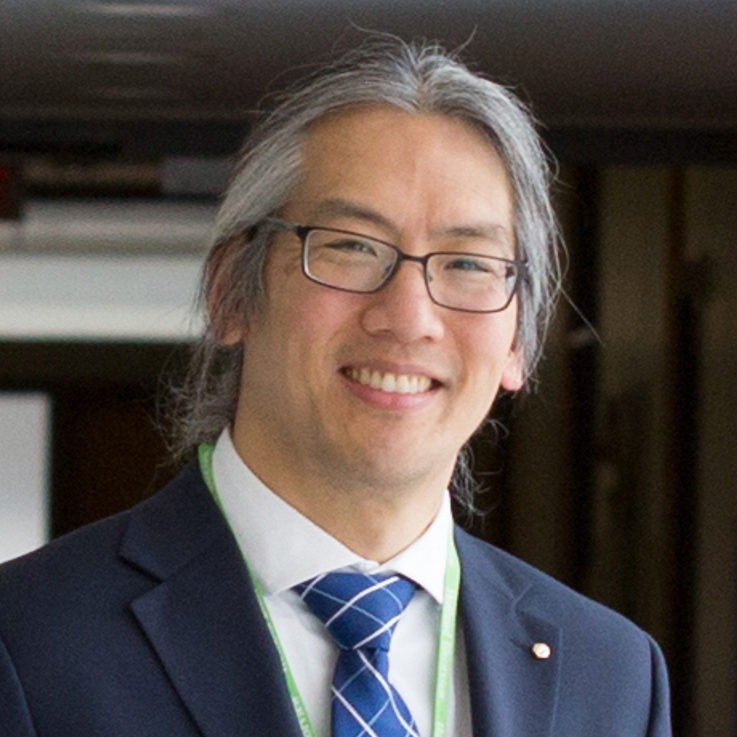
Like many new fathers, Dr. Tom Chau marvelled at “what a miracle it was to have a healthy child. I thought what a struggle it must be for new parents when things did not fall into place.”
He came to this realization first hand: His mother, who worked in palliative care, took him and his siblings along as volunteers to help feed patients who were severely disabled. Then, with the birth of his own son in the late 1990s, Dr. Chau saw that his training in electrical and computing engineering could be put to better use than in his position at IBM, where he revamped business processes for manufacturing companies.
“I had a real hunger to do something that had a more direct human impact,” recalls Dr. Chau. He quit his job and contacted Toronto’s Bloorview Research Institute, which develops assistive technologies for disabled children. He soon found himself in postdoctoral studies as a biomedical engineer in order to secure funding for his research on novel “access pathways” for children and youth born with severe congenital conditions. “I never looked back,” he says.
‘Reimagining the way we communicate’
Today Dr. Chau is director of the institute and Vice President of Research at Holland Bloorview Kids Rehabilitation Hospital. His work focuses on developing technologies that give voice to the voiceless, helping non-verbal people who also have severe physical impairments.
“We are boldly reimagining the way we communicate,” says Dr. Chau, who is also a professor in the Institute of Biomaterials and Biomedical Engineering at the University of Toronto.
“We believe that the body is communicative, even in the absence of speech and gestures. It’s just that we’ve never been attuned to listen.” – Dr. Tom Chau
Areas of research for his multidisciplinary team include hemodynamic signalling, harnessing the flow and oxygenation of blood in the brain to allow mere thoughts to control a computer. His lab also has developed devices like the “hummer”, a sensor that sits on the neck to detect the vibrating of the vocal folds, allowing the person to choose letters on an on-screen keyboard. “We’ve got over three dozen kids who are now able to do their school activities and control things in their environment, simply by humming.”
Another discovery was facial thermography, which uses a camera that’s sensitive to temperature variations on parts of the face to control devices. It started with a 25-year-old with severe cerebral palsy and scoliosis who could open and close his mouth, a particularly warm spot, to make selections from a grid of letters as they were highlighted one at a time. “After two years of working with him, we didn’t know his literacy level, if he could spell or recognize words,” Dr. Chau recalls. Positioned in front of the thermal camera, he slowly typed M-U-T-H-E-R.
“The first word he said independently was ‘mother’. He called out to his mother, at 25. That was a real emotional moment for us—and for his mom.”
‘A cure is not part of the conversation’
Such breakthroughs have had a profound impact on individuals, families and caregivers. But funding remains a struggle, especially where the beneficiaries are relatively few, solutions are customized, improvements are incremental and “a cure is not part of the conversation,” Dr. Chau admits. “Granting agencies want you to demonstrate that your research is going to have economic impact.”
Advances in consumer electronics, from smartphones to smart homes, have made technologies for those with disabilities more accessible and affordable. However, these must be tailored to the unique abilities of the individual and significant training is required. “It’s much like learning a new language,” he says. “You can’t just give somebody a device or an app and say, ‘Go away, problem solved’.”
Dr. Chau is inspired by young researchers in his field “who want to create a truly meaningful and healthy future for our kids.” And he hopes that Canada recognizes the importance of interdisciplinary work, which can fall through the cracks but brings some “unconventional approaches that, in the long run, serve us really well.”
Many adults with stroke, ALS or degenerative conditions like multiple sclerosis could potentially benefit from the technologies the lab is currently developing for children. And there is much excitement over the prospect of a direct brain-computer interface. The notion has attracted attention from sources like Neuralink, the neurotechnology company founded by Tesla’s Elon Musk, as well as Facebook, given the possibility that such technology could be used in areas like gaming and virtual reality, Dr. Chau says. “It certainly helps us to move the needle in terms of advancing that kind of research.”
The proudest moments for me …
… are what are called the ‘first-word moments’, where children who have been silent their entire life have been able to communicate for the very first time. For some of these kids, their first word was a video game. For one, his first words of communication were ‘I want a great big hug’. I think those are the moments where we felt the greatest affirmation about our work.
What’s your advice to innovators?
Fear limits our creativity, and it’s really easy to dismiss an idea. But I think everybody deserves a point in time in their life where they can just go crazy with their ideas. You never know where they will lead. I would encourage people to challenge the status quo and think differently. Things don’t always have to be the way that they are.
An inspiration in my life …
… was Tom McKillop, our parish priest, who devoted a good portion of his life to working with young people. He was a mentor to me. His advice that stuck with me the most is: ‘If you’re not encountering difficulties, you’re probably not in the right job. If you’re dealing with persecution on a daily basis, then that’s the right job for you.’
Read about the other 2018 honourees
Related Articles