


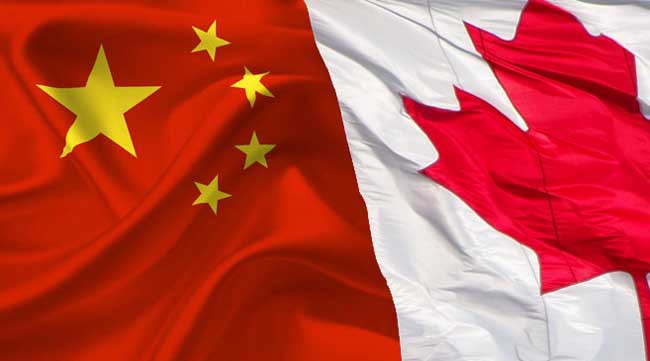
Canada’s China puzzle: We need a national discussion
How should we relate to an economic, political and increasingly technological powerhouse of 1.3 billion people with different political and legal values?

By Edward Greenspon and Kevin Lynch
Edward Greenspon is president and CEO of the Public Policy Forum. Kevin Lynch is vice-chair, Bank of Montreal, and former clerk of the privy council.
Canada has a China puzzle it needs to solve. We want our kids to have good jobs and live in prosperous communities. That takes economic growth. For a trading nation like Canada, growth necessitates access to markets for our goods and services.
Unfortunately, the United States — which is by a factor of nearly 10 our largest trading relationship — no longer treats Canada as a privileged friend. With its reduced reliance on petroleum, polarized and petulant politics, and protectionist sentiments popping up from softwood lumber to steel, aircraft, procurement and beyond, Canada needs to hedge it bets. Donald Trump adds a layer of erraticism.
Contrast this with China, the second-largest economy in the world and growing at three times the pace of the United States. Canada has long-standing relationships with China. In the 1960s, John Diefenbaker ignored an economic embargo to sell it wheat. In the 1970s, Pierre Trudeau was applauded for ignoring a political embargo to accord diplomatic recognition in the midst of the Cultural Revolution.
Since then, China has shifted from dependence toward dominance. When the world economy crashed in 2008–09, China and the rest of Asia provided much of the global demand that helped keep the Great Recession from becoming another depression.
Yet China is different, very different, from the countries with which we typically negotiate trade deals.
It is not a democracy. It does not treat human rights as we do. It engages in extra-territoriality, whether in the South China Sea or cyberspace. Its state-owned enterprises don’t always draw a sharp distinction between commercial activities and political objectives.
Thus the puzzle — how to relate to an economic, political and increasingly technological powerhouse of 1.3 billion people with different political and legal values.
Do we want to turn away, which would leave Canada, not China, isolated? Do we want to allow matters to drift, with no clear and consistent policy objectives, no national strategy? That’s certainly not the path chosen by like-minded countries in Europe, or by Australia and New Zealand. It amounts to suppressing our sovereignty rather than expressing it.
Or do we take control, by accepting that China isn’t going away and figuring out the best ways to engage it? The inevitability of China’s presence in our lives and the need to manage this reality is why Canadian trade union leaders are organizing delegations there.
Last week, the Public Policy Forum held the first roundtable of its Consultative Forum on China, of which we are the co-chairs. The group includes business leaders, academics, public servants, a former prime minister, a former ambassador to China and a former trade adviser in Stephen Harper’s PMO. We discussed what we can discern from four major public opinion polls in the past two years about what Canadians think of this relationship. We also began to think through what approach Canada might take if it were to negotiate — whether a comprehensive deal as with NAFTA and CETA, or something more phased or with non-commercial elements.
We discussed security and human-rights concerns and commercial opportunities in areas such as agriculture and clean tech. We talked about how medium-sized enterprises can be helped to penetrate the Chinese market and the amazing success of Atlantic Canada’s fish-processing industry in exporting to China. We talked about unambiguous common interests and shared interests, such as the environment. We talked about the mismatch between hundreds of thousands of Chinese students studying in Canada versus fewer than 5,000 Canadian students receiving similar exposure to China.
Nothing was resolved. This was the first of many conversations. The focus was on beginning to figure out where Canada’s advantages lie and what will be acceptable to Canadians, given the mixed messages of the public opinion research so far and the significant number of undecideds. It was noted that in 1986–87, similar polls showed Canadians opposed to free trade with the United States, a position that changed as the agreement was designed, debated and implemented.
We don’t know the federal government’s intentions on China. We’re not even sure they do yet. The Consultative Forum is meant as a gathering place of knowledgeable people who can take the China puzzle and provide some good ideas for solving it in a manner both economically beneficial and politically satisfactory to Canadians.
This article appeared in The Globe and Mail on June 26, 2017.
Related Articles