

PPF Media
Don Mills: ‘I don’t want to talk about potential any longer. I want to talk about getting s–t done.’
Disponible en anglais seulement
Partagez


Publié:4 novembre 2026
Project: Prix Frank-McKenna
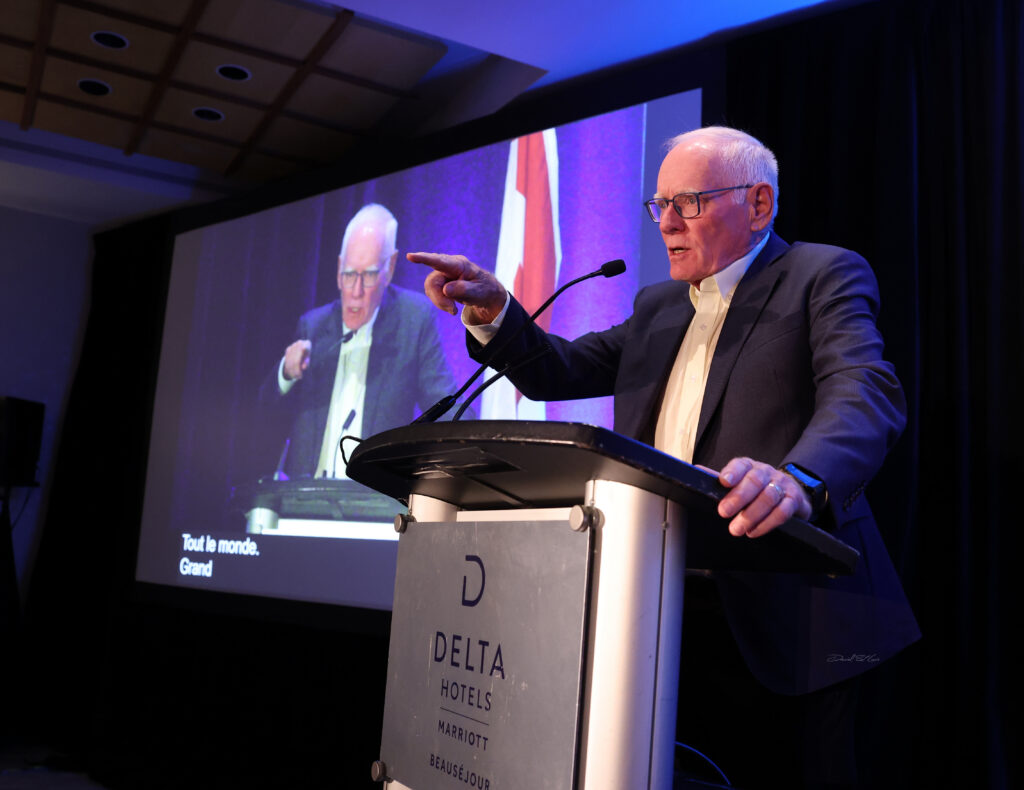
Don Mills, who chaired the Atlantic Economic Panel, was an honouree at the 2026 Frank McKenna Awards, which recognize exceptional leaders whose contributions to public policy have strengthened Atlantic Canada and the country. Mills is the president Crane Cove Holdings Ltd, a podcaster, author and long time business leader in the region (see PPF’s profile of Mills here).
Read his acceptance speech about the urgent need for immigration and action to drive regional growth.
The transcript has been lightly edited for length and clarity.
I’m very grateful and honoured to receive this award. It’s especially meaningful for me because it’s named after Frank McKenna, someone who I have the ultimate respect for.
For those who may not know me, I spent 40 years tracking opinion of premiers in this region, meeting with them, presenting to the caucuses, got to know them all a little bit and I’ve said this before, so it’s not the first time I say this: I consider Frank to be the most consequential premier that we’ve had in this region in my lifetime. This is not to be a roast for Frank at all, but he continues to advocate for his home province in the region. He’s a champion for our region, and I really admire the fact that he continues to try to make our region better. So on behalf of everybody here, Frank, thanks for your continuing work on our behalf.
You’re going to get a little bit of what I’ve been trying to do for more than 40 years, closer to 50 years. I use my market research company as a platform to talk about the challenges in this region, and I use data to support the positions that I took. It really was easy because nobody else had the data. I didn’t actually get a lot of pushback on the things I was saying.
I tracked the opinions and habits and of Atlantic Canadians for nearly 40 years and trended them year in year out, and I learned a lot of things about that. I also did a lot of work on demographics and population growth. I think I stand to be corrected, but I actually talked about it when Frank was in office, if I’m not mistaken. So that’s how long ago it was, and you know, you could see what was coming on the demographic side. I started advocating for immigration probably before most people. I could see that we needed to attract more people to this region. We had no immigration in our history. We are still the lowest proportional region in Canada in terms of having people who are from elsewhere. The last census was 6 percent. It’s probably going to be 7 percent in the next census. Well, the country’s at 24 percent.
If you look around the room, there’s not a lot of diversity in this room. You know, that’s a big challenge for our region. I just want to say we need to be able to live with diversity and welcome it. It’s very important. I think everybody in this room would probably agree with that.
The other thing is that for most of my career, I looked at the numbers. I’m trying to figure, why is Atlantic Canada always underperforming the rest of the country, year in year out? What’s wrong with us? Are we are we not that bright? Are we not that ambitious? Do we not have the resources to compete with the rest of the country? I started putting together theories. Some of you have heard these theories over the years, but there are some structural issues that are really key to our problems here. One is that you know we have twice as many people living in rural parts of our region and elsewhere in the country, that makes it really hard to give them full-time jobs, especially when you don’t develop their natural resources, which has become a thing here. That’s a big issue.
The other structural issue, and it’s really problematic, is the fact that we have way more people working for the public sector and way fewer working for the private sector in this region compared to the rest of the country. How can you even be average in economic growth when your private sector is proportionally small? It’s almost impossible to do.
But those are only structural problems. And then I realized what the really big problem was, and it had everything to do with population. You know, we spent 30 years, ladies and gentlemen, from about the early 90s — when baby boomers stopped having kids, by the way — to about the mid 2015s, where we had stagnation in terms of population growth. And over that period of time, what happened? We became super dependent on government.
Our attitudes got warped by that to some extent. We became the heaviest taxed region in the country. Why is that? Because we had the same number of taxpayers paying ever increasing tax bills. That’s what’s happened. How do we get out of that?
The Atlantic Economic Panel is the culmination of 50 years of effort to understand what our challenges are, what our opportunities are, and I can assure everybody in this room that we have the ability to be a ‘have’ region, 100 percent, but only if we have the ambition to seize the moment and the political will to get it done.
I don’t want to talk about potential any longer. I want to talk about getting s–t done. And every person in this room has a vested interest in supporting the recommendations of that report, and I’m very glad to see that the Public Policy Forum has actually adopted some of our major recommendations because they’re really important. Only if we eliminate all the interprovincial trade barriers in our region and create a free trade zone, will we immediately have a bump in GDP growth. Immediately. We don’t have to wait a year, two years, five years. It will happen immediately. Can we get that done? Is that possible?
The Public Policy Forum just came out with a report by my buddy, my co-author, my co-host of the podcast, called Help Wanted. If you run a business, read that report. It will scare you to death. It will scare you to death because what it tells us is that in the next 10 years — in the next 10 years — we’re going to be short [441,000] workers. They’re not here. We don’t have them. We have more people dying than being born, which means we’re going to have to import workers, maybe from the rest of Canada, but more likely from the rest of the world.
By the way, that’s based on 2 percent GDP growth, which, from the panel’s point of view, is too low. We have more ambition than that. We want to be 2.53 percent. What’s that mean? 300,000 plus workers that we do not have, that we need to grow our economy. The only way we’re going to get them is through immigration, and so our panel has recommended very specifically that we grow our population by 1.8 percent. We allow 25,000 international students to come in to our universities and provide us with one of the best routes for immigration. If we don’t do that, and we don’t start today, not going to happen.
It leads to one of the biggest recommendations, which is that we need to have a made-in-Atlantic Canada immigration strategy. And the only way we’re going to accomplish that is if the four premiers get together and insist that we have a made-in-Atlantic Canada immigration strategy. Why is that? It’s because we actually have some authority, some responsibility on immigration. We need to take that back, just like Quebec is taking it back, just like Alberta is trying to get it. We need to be there and get that done. So, I’m watching.
I just want to thank the Public Policy Forum for these awards. One of the things that we don’t do well enough in this region is celebrate business success. It’s one of the reasons David and I have been doing the podcast for five years, for anytone that listens to that. We want to shine a light on successful companies and we need to do more of that. I also want to congratulate the Forum for its focus on Atlantic Canada. It’s the first time we’ve had a national think tank focus on our region. We referred to the first Momentum Index in the book that David [Campbell] and I wrote as an indication that something is changing in this region. We also warned in our book that is we didn’t continue population growth we’d be in trouble.
We’re near there now. I’m ringing the fire alarms. We’re going to lose our momentum if we don’t get back to population growth. What is the population growth? 1.8 percent.
« Des tables plus grandes, des récits plus riches, un impact plus large. »
Inez Jabalpurwala, Présidente-directrice générale du Forum des politiques publiques
Notre travail rassemble des dirigeants accomplis et de nouvelles voix qui produisent des idées pratiques et robustes pour des politiques au service de tous les Canadiens.
