

PPF Media
Frank McKenna on Canadian ambition and America after the midterms
At the 2026 Frank McKenna awards, the former premier and ambassador to the U.S. talked about how to overcome Canada’s challenges and why the federal government ‘is really on fire now’
Disponible en anglais seulement
Partagez


Publié:5 novembre 2026
Project: Canada-US, Prix Frank-McKenna
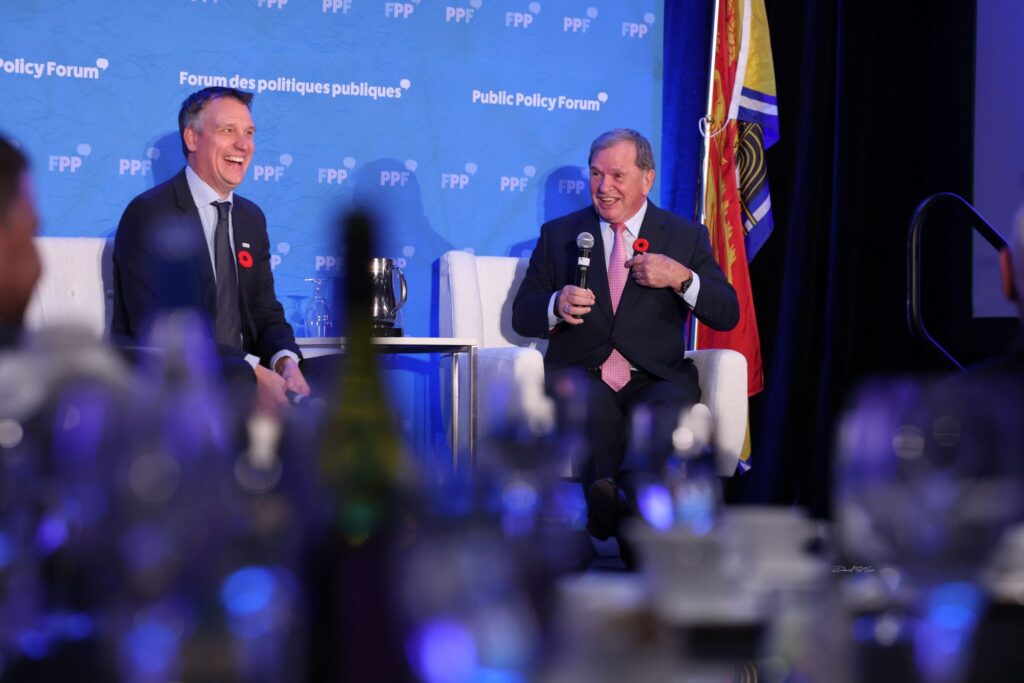
At the 2026 Frank McKenna Awards in Moncton on Oct. 29, Frank McKenna sat down for a fireside chat with Scott Moore, Executive Vice-President, Finance and Chief Operating Officer of Export Development Canada. They talked about the need for more immigration in Atlantic Canada, the problem with separatist debates in Alberta and Quebec and why Donald Trump is bad for America.
This transcript has been edited for length and clarity.
Q: We’re going to start with the 2026 Atlantic Canada Momentum report. The first report in 2023 showed solid momentum. The one in 2024 showed lesser momentum. The most recent shows further challenges. One could see that as disappointing, but there’s also lots of opportunities. How do we take advantage of the strengths of the region?
A: The first several years of the momentum report, we were experiencing strong population population growth across the region. The GDP was increasing as a result of that. The finances were manifestly improved as a result of population growth, transfers increased, sales tax increase. A lot of good things were happening, and it created a lot of momentum across the region. And all we were doing was experiencing what everybody in Canada has experienced in the last 100 years: growing populations.
But what we know too well is that population or immigration, if you ask people to come to Canada, they will. Eighty-five percent of them will end up in Montreal, Toronto, Vancouver, Calgary, and they go there not just because there’s opportunity there. It’s more than that. People go where people are. If you’re if you’re from some country in the world, Nigeria, you want to go where Nigerians are, where there’s a Nigerian restaurant. If you’re a Filipino, you may want to go where church services are available, or people of your community. And because we never had a chance to lay down roots in Atlantic Canada, people who would come here would be transient and move on because they did not find their community here.
So some years ago, we were all successfully able to convince the government of Canada of that fact, and they created the Atlantic Immigration Pilot, and that gave us preferred access, and it gave us a chance to establish settlement programs that allowed roots to be placed in our community and the population not only to grow but to be retained, and so we were on a positive track. As a result of that, and I think that rising tide lifted a lot of boats. The trouble is in Canada, and it’s not a lament; it’s just reality, is that when Upper Canada catches a cold, all the rest of us catch the cold along with them. Part of Canada ended up abusing the immigration system, especially in the institutions of higher learning, and we ended up overburdening the system. And as a result, they stopped, slowed down immigration across the board. We ended up suffering, even though we were not part of the problem.
When I speak to Don [Mills] about his report and others, I’d say that should be the first recommendation. Getting that population right is key to everything. We need the blood, we need the consumers, we need the skills, we need all of those things.
I think we’re getting there, convincing the government of Canada that has to be restored. And by an accident of faith, the country is skating towards us. Alberta has a whole referendum concluding they want control over immigration because they want less. Quebec want less, so I think we should say to Prime Minister Carney, hey, we want more.
Q: The region is behind the rest of Canada in innovation, investment, competitiveness. There have been efforts over the past, fixes that haven’t necessarily been long-term fixes. What needs to be done to catch up to the rest of Canada across some of these key areas?
A: It’s a multifaceted problem, but remember we are kind of a remote geography, and with a sparse population base, so that matters a lot. Toronto is critical mass. I don’t have to be very smart in Toronto to make a living because there’s so many opportunities. I’m an example of that. Other parts of Canada have extraordinary resources, access to oil or gas, and the Pacific Ocean on the Pacific Coast. British Columbia has had a flood of extraordinarily talented, often wealthy immigrants from Asia. So we haven’t had the advantage of all of those things. What we have to we have to make our own good fortune here.
The nice thing about being in the situation I’m in is you can say really stupid things and get away with it. Or at least controversial things. One, we’re on the wrong side of the Quebec divide, and Quebec really cuts us off from the rest of Canada. We know because we couldn’t get an oil line from Western Canada to come to the East Coast. We’re importing 500,000 barrels a day and can’t get a molecule of Canadian oil, and they’re exporting oil to other places because we couldn’t get through Quebec. Recent efforts were made to try to get gas through Quebec to Saint John and we couldn’t do it because Quebec says no. So we have that constant problem that we have a difficult neighbour in terms of in terms of our access to the rest of Canada.
Secondly — and again, this will I’m sure be controversial — because we’re a region that has grown through seasonal industries we’ve lost some of our muscle mass. Talk about productivity. It’s hard to create maximum productivity when your plant works 14 weeks a year. It’s hard to have the most engaged labor force when they have the attraction of unemployment insurance for a good portion of the year. That’s not to say that we don’t have to find ways to be supportive of our population, but it is to say that we can’t continue to atrophy our muscles. We have got to create a more full-time, highly skilled, competitive labour force that competes against the full world.
Part of it is immigration again, enriching the bloodline by bringing in people who have to work hard and face adversity in order to get by. Bring them in to make us as hungry and keen and ambitious as they are.
Q: If we go back a few years ago, I think nobody would have predicted the uncertainty, some of the trade issues that are in front of us, the conflict around the world. If you were premier today, what would you be doing to prepare this province and the region for the future?
A: Well, I would be getting some canned goods and going to a cabin. Man, if I were premier today, holy cow! I mean, there’s just so many challenges. Look, this too shall pass, in my belief. I believe that that President Trump is an aberration that won’t be repeated. I truly believe that he’s an agent of chaos that will be disappearing from our screen in two years. And I think that he’ll be somewhat hobbled , because what he’s doing is not good for America. He’s got a tariff on aluminum of 50 percent, when 70 percent of the aluminum comes from Canada. Americans are paying not only that but a markup and they’re desperate for for aluminum to use in secondary industries.
Canada is the biggest market for U.S. autos. A lot of people wouldn’t know this — I didn’t know it. I looked at the stats; I couldn’t believe: We buy more automobiles than China, South Korea, Germany, and Mexico combined. We buy 2 million autos a year, almost all of them from America. Guess what? Auto sales from America to Canada are down 20 percent this year. Now, how smart is that? That’s why not only the auto companies, but the auto unions in the United States are pleading for a trade deal.
So, the premier’s got to deal with that issue. She’s got to deal with the issue of having to pay the bills for a health care system and an education system at a time when our revenues are not increasing. We’ve got to deal with all of the disruption that’s coming about in our country as a result of trying to reconfigure our economy to find other markets around the world. These are are really intense problems.
I admire the leadership of our country today. I think, particularly at the national level, the government of Canada is really on fire now. The government of Canada is convinced that we either get our s–t together, or we will become the 51st state of the United States. I’ve never seen such urgency and such impatience at the national level. At the provincial level, I have not seen the same sense of urgency and the same sense of ambition quite yet that we’re seeing at the national level. But this is a different country today than it was even a year ago.
Q: You were the ambassador to the U.S. at one stage in your career, and therefore know the relationship very well. There’s been lots of conversation about what changes after the midterms.
A: There are a lot of unknowns, but we know it’ll create more gridlock, a lot more gridlock, and that is not a bad thing. America has always functioned well with gridlock. The private sector actually likes gridlock because they think government inherently does bad things to them, and they would prefer to have less government and more private enterprise. So I don’t think it’ll slow down the public markets or the economy.
In the case of Trump, will he become enraged and just lash out in every direction? Will he become more compliant and try to work with Congress? That’s not been his personality today. My hope is that Congress will reassert itself. There’s a standing joke now that in order to run for Senate in the last couple of years, you’ve had to have an MRI to find out if you had a spine because if you had a spine, you don’t want it. Well, right now I’m hoping that we get senators and congressional leaders with spine who are going to take back some of their authority.
It was the Congress that signed off on the free trade deal that we used to call NAFTA and CUSMA. It should be going to them rather than Trump unilaterally making a decision to breach every term that he agreed to before. This should be a decision of Congress, and so we need them to get some spine and fight to get that jurisdiction back.
Congress, if it reverts to be to the alternative party of the Democrats, I think they’re really going to assert themselves. Then we’ll see what happens whether Trump can continue to lash out all over the place as he is pushing his authority to the very limits of what’s constitutionally allowed.
Q: So I would summarize by saying we need a little bit more of Congress and a little bit less of the sharpie.
A: It’s the pencil that’s bothering us. When you do deals in pencil, you know what you’re getting. So we need less of that.
I feel quite encouraged about our prospects. There’s a chance that we could have a deal with the U.S. Not because we’re calling to them looking for a deal, but because the Americans really need a deal.
I think that we continue to do what we’re doing, which is wanting to do business with our American friends, allies, neighbours, trading partners, but also reasserting ourselves to the world and opening up resources, opening up new veins of wealth within the country, dealing with our own problems, getting permitting done, creating natural wealth within Canada. At the provincial level, I I want the other premiers to be like our premier in New Brunswick, basically saying tear down this wall, and let’s have free trade across the board amongst all of the provinces. think Prime Minister Carney wants that to happen, and some of the premiers want that to happen. And hopefully, the public puts enough pressure on to make that happen.
I’ve never seen as many positive and good things happening within our country as a result of this crisis that we’re facing, so that is the flip side of what’s taking place right now.
Q: Maybe we can go back a little bit and welcome your perspective on any lessons from the past that we should be thinking about as we navigate this version of uncertain times?
A: We’ve always had a relationship with the United States of America that’s been extraordinarily fraught. We’ve got the world’s largest border, so you’re always going to have stuff. But we’ve worked it out. We’ve got a Great Lakes Commission. We’ve got an International Joint Commission. We’ve got NORAD. We’ve worked it out. We always were able to disagree without being disagreeable, and we always set the tone at the top of grown-ups who would work over the top of issues — that’s how we ended up with free trade with Reagan and Bush and so on.
In terms of domestic crises, look, today seems challenging, and it is. The fiscal houses now are in dangerous shape. We’re going to have to do hard things. We just can’t keep printing money forever. But we went through this in 91, 92. We hit the wall in Canada. The Wall Street Journal ran an editorial saying that Canada is on the verge of being a third world country. We had a revolt of the bond vigilantes who weren’t prepared to service their debt anymore. Chretien and Martin ended up getting elected, and they did some really hard things. They ttook a lot of costs out of government. They downloaded a lot of costs to us on the provincial level. We had a massive deficit. We literally laid off 5,000 public servants, closed 1,000s of hospital beds, closed small community hospitals, froze wages. We had so many people striking, they ended up having a hot dog stand in front of my house. But we had to face into it because we had no choice. The result of that is that we all ended up getting our fiscal house in order, and we actually ended up paying down debt, lowering the cost of debt service, actually reducing some taxes, creating a better environment to create wealth, to pay taxes, and we got in that virtuous circle, which is the reason today that Canada is in one of the best positions in the planet of countries going through this fiscal crisis, because of the sacrifices that were made back then.
I just want to exhort people in positions of power to face up to this. It’s hard work and it’s painful work, but we will get through it. And if we do, we’ll end up being strong enough to face whatever comes at us.
Q: A topic that has come up may time is a ‘one Atlantic Canada’ economic plan. What would need to happen to bring that together?
A: I think the government of Canada has to be there. It’s hard for each provincial premier to convince other premiers to do certain things, and then having to defend it in their own province as well. The government of Canada has shown this last year they’re prepared to weigh in and put their thumb right on the scale. They go to Alberta, they go to British Columbia, and convince them that there should be an oil pipeline. That only works because the government of Canada’s at the table. They go to Newfoundland and Labrador, and Quebec, and say we think that Churchill Falls should go, but it’ll only go if you put your thumb on the scale and put something in the window in order to make it all work.
Q: I want to ask you what you think about what’s happened in Quebec. The new premier is unhappy with Mr. Carney. You’re somewhat of an expert on unhappy Quebec nationalists. How you think this is going to play out?
Well, it’s to me, it’s just a crying shame. We’ve been through two referendums in Quebec, and at some point in this country, we’ve got to make up our mind. You just can’t keep swinging until you hit something. Are we going to be in a country where you can whiff on five referendums, but you happen to catch the right circumstance on the sixth one, say, « Whoops, I’m out of here. » That’s a hell of a way to break up a country.
I don’t think Quebec will be leaving Canada. I think the hurdles are way too high. Not only do they have to have a referendum, but they have to have a clear majority and a clear question. And a clear majority, in my view, is not 50 plus one. It’s more likely 50 percent of all the people in Quebec. They have to face the question of divisibility. If Quebec is divisible from Canada, are First Nations divisible from Quebec, and more importantly, would Montreal be divisible from Quebec because I can’t see Montreal being hauled kicking and screaming out of Canada.
Alberta, the same thing — the most ridiculous thing that we’ve seen in decades: a referendum where less than 10 percent of the people really want to separate. Ninety percent of the people in Calgary voted to remain. So what are you going to do? Say, yeah, we’re leaving, and you’re coming with us, even if you don’t want to? I don’t think so. People aren’t thinking about the huge problems that you would face. You get into the issue of the credit rating of Quebec and the cost of borrowing, et cetera, et cetera.
At some point, we’ve got to wake up and realize we’re in the best country on the planet, and stop trying to break it up. That’s just wrong. What’s going on with that? It’s just a taste of what we’re going to go through for the next two and a half years. This [Quebec] government is being mischievous. They’re trying to contrive excuses to feel like we’re beating up on them. In this case, the premier doesn’t get to address the European Union, even though he’s invited to sit at the table and make opening remarks.
Prime Minister Carney is showing incredible patience dealing and he’s going to have to have extraordinary patience with Quebec as they systematically work to try to undermine the country. Right now, they formed a government with 28 percent support. They’ve got a mandate to do nothing.
« Des tables plus grandes, des récits plus riches, un impact plus large. »
Inez Jabalpurwala, Présidente-directrice générale du Forum des politiques publiques
Notre travail rassemble des dirigeants accomplis et de nouvelles voix qui produisent des idées pratiques et robustes pour des politiques au service de tous les Canadiens.
